
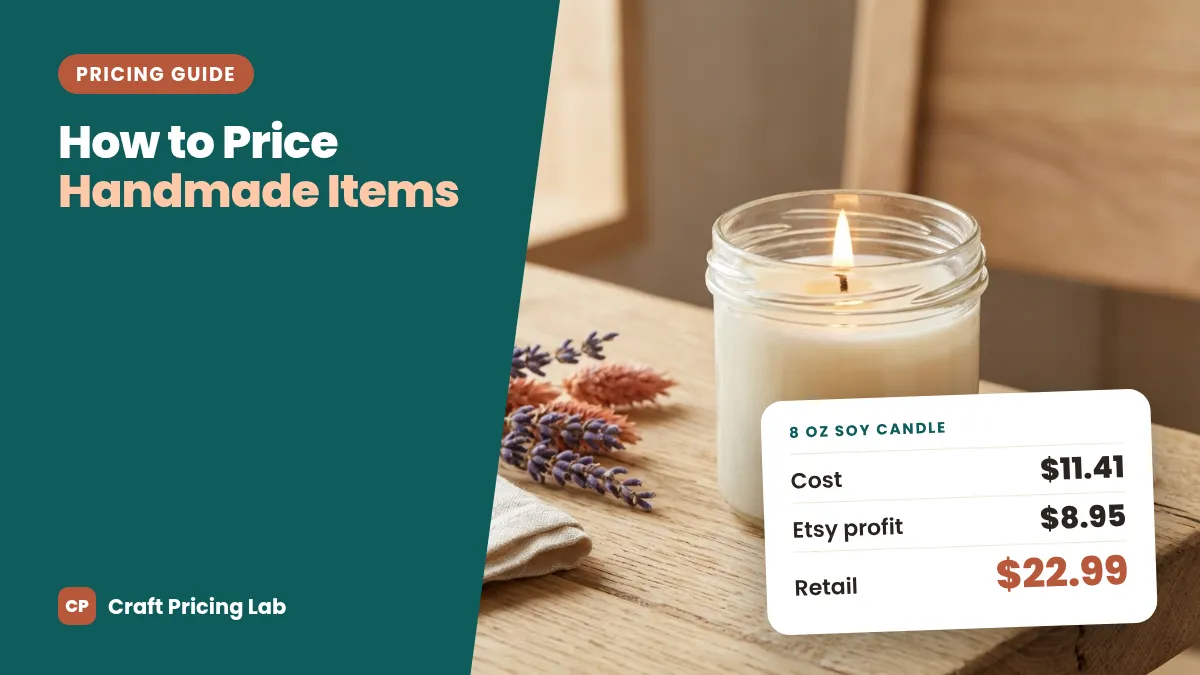
Pricing by gut feel can leave a busy month with very little money in it. Here is how to price handmade items so each sale pays you: add up your real cost per item, add a profit margin, and cover the selling fees. Then check your price against what similar items list for.
The short answer
- Cost per item = materials (with waste) + your labor + packaging + a share of overhead.
- Retail price = cost ÷ (1 − target margin). A 50% margin means cost ÷ 0.5.
- Fees come out of the price, so check your profit after Etsy, card or booth fees.
- Market check: compare your price with the median of 15 to 25 similar listings.
- If the formula lands far above the market, change the product or the cost, not just the price.
What goes into the price of a handmade item?
A fair price starts with your cost per item, meaning the money and time one finished piece really uses up. Accountants call the product part of it cost of goods sold, or COGS. For pricing, you also add a slice of the costs that keep the shop running.
There are five parts, and if you leave one out, your profit shrinks without you noticing. The table shows each part and the simple math behind it.
| Cost part | How to work it out | Easy to forget |
|---|---|---|
| Materials | Price paid ÷ package size × amount used, for each material, ÷ items in the batch | Glue, thread, fragrance, findings |
| Waste | Materials × (1 + waste %). Start with 5%. | Test pieces, spills, offcuts |
| Labor | Hourly rate × (making minutes + admin minutes) ÷ 60 ÷ items in the batch | Photos, listing, packing, messages |
| Packaging | What leaves the house with each order | Tissue, stickers, care cards |
| Overhead | Monthly fixed costs ÷ items you sell per month | Software, tools, booth gear, a share of rent |
Shipping is left out of this list on purpose, because you can charge it as its own line or build it into a separate free-shipping price. Treat it as its own decision so it does not hide inside your cost.
Keep your numbers in one place. A simple sheet with one row per material and one row per product is enough. Our free templates follow the same five parts, so the math in this guide drops straight in.
How do you figure out the materials cost per item?
You buy supplies in bags, spools and cases, but each item uses only part of them. So you price the part you use. Divide what you paid by the package size, then multiply by the amount one batch uses.
Here is a real-style example for a batch of twelve 8 oz soy candles. These are example inputs, not market prices. Swap in your own receipts.
| Material | Working | Batch cost |
|---|---|---|
| Soy wax | $32 ÷ 160 oz × 96 oz | $19.20 |
| Fragrance oil | $24 ÷ 16 oz × 9.6 oz | $14.40 |
| Jars (12) | Bought as a case of 12 | $22.00 |
| Wicks | $9 ÷ 100 × 12 | $1.08 |
| Labels | $8 ÷ 24 × 12 | $4.00 |
| Total for 12 candles | $60.68 |
Now spread the batch over the items and add waste: $60.68 ÷ 12 × 1.05 = $5.31 per candle. The 5% covers a cracked jar, a sink hole you fix with extra wax, or a test pour.
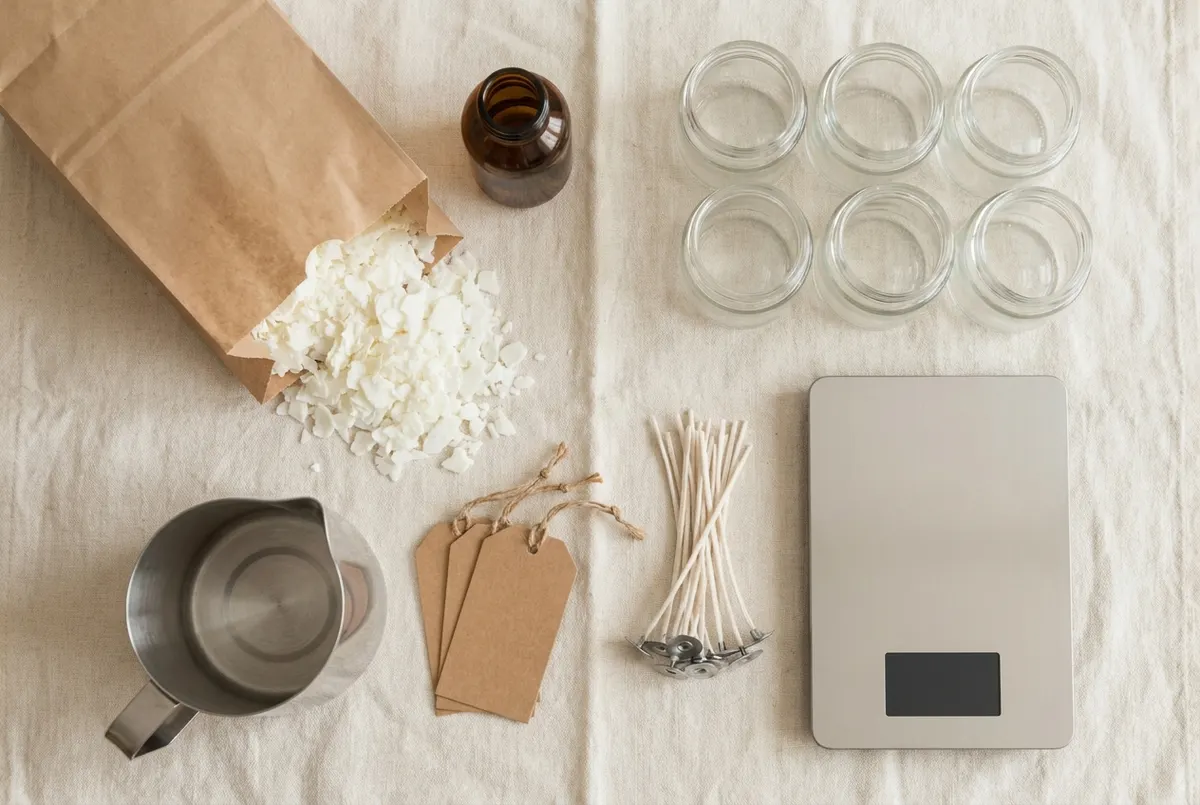
Two habits make this step accurate. First, use what you paid last time, including shipping on the supplies. Second, weigh or measure one batch instead of guessing. A kitchen scale and a notebook are enough to find out that a “small” amount of fragrance is really 9.6 oz.
How much should you pay yourself per hour?
Your time is a cost, even when you enjoy the work. If you leave it out, your price only works while you make things for free. Pick an hourly rate before you look at any market price, so the market does not talk you out of it.
A useful floor is the US federal minimum wage, which is $7.25 an hour according to the US Department of Labor (checked October 12, 2026). Many states set a higher minimum, and skilled work is often worth more. Our candle example uses $20 an hour.
Count two kinds of time. Making time is pouring, curing, sewing or stringing. Admin time is photos, writing listings, answering messages and packing orders. Admin time is easy to skip. In the candle example it is a third of the total time.
For the candle batch, making takes 90 minutes and admin takes 45 minutes. So labor per candle is $20 × (90 + 45) ÷ 60 ÷ 12 = $3.75. Making in batches is the biggest lever here. The same 135 minutes spread over 24 candles would cut labor per candle in half.
Add the last two parts and the cost is complete. Packaging is $1.10 per candle, and overhead is $150 a month spread over 120 items sold, or $1.25 each. The full cost per candle is $5.31 + $3.75 + $1.10 + $1.25 = $11.41.
Which pricing formula should you use: a multiplier or a margin?
Once you know your cost, you need a rule to turn it into a price. Two rules come up again and again in pricing advice. They give very different answers, so it helps to understand what each one assumes.
The classic multiplier says cost × 2 = wholesale, and wholesale × 2 = retail. It was built for makers who sell to shops, because a shop needs to double your wholesale price to pay its own bills.
The margin method asks a simpler question: what share of the price do you want to keep after your costs are paid?
Markup and margin are easy to mix up: markup compares profit with cost, while margin compares profit with the selling price. A $10 item that sells for $20 has a 100% markup but a 50% margin.
| Method | Formula | Candle at $11.41 cost | Best for |
|---|---|---|---|
| Cost × 2 × 2 | Wholesale = cost × 2; retail = wholesale × 2 | $45.99 retail | Sellers who also stock shops |
| 50% margin | Retail = cost ÷ (1 − 0.50) | $22.99 retail | Direct sales on Etsy, fairs or your site |
| 40% margin | Retail = cost ÷ (1 − 0.40) | $19.99 retail | Crowded markets with low prices |
All prices in this table are rounded up to end in .99, which is the default in our calculator.
Our calculator uses a 50% margin by default because, in our market check below, the classic × 4 rule landed above the median listing price for all four example products. If you plan to sell wholesale, the multiplier still matters. Use it to test whether a shop could ever stock you.
How much do Etsy, craft fairs and your own website take?
Fees come out of the price the buyer pays, so the same price leaves you different money on each channel. The figures below come from each platform’s own fee page, checked on October 12, 2026.
| Channel | Fees on a US sale | Fees on a $22.99 candle | Source |
|---|---|---|---|
| Etsy | $0.20 listing + 6.5% transaction + 3% + $0.25 payment processing | $2.63 | Etsy fees policy, Etsy Payments policy |
| Etsy Offsite Ads | Extra 15% on a sale from an ad (12% once your shop passes $10,000 in yearly sales), capped at $100 per order | +$3.45 if the sale came from an ad | Etsy fees policy |
| Craft fair with a card reader | 2.6% + $0.15 per in-person card sale on Square’s free plan, plus your booth fee | $0.75 + booth share | Square pricing |
| Your own website | 2.9% + $0.30 per online card sale on Shopify Basic, plus the plan fee | $0.97 + plan share | Shopify pricing |
Etsy charges the 6.5% transaction fee on shipping and gift wrap too, and the processing fee on the full order. Your real Etsy fee is a little higher when you charge shipping. Put your monthly plan or booth cost into overhead, not into the per-sale fee.
A simple decision rule helps here: if fees take more than about 15% of your price, a small item is carrying a fixed fee that is too big for it. Raise the price, sell a set, or move that product to a channel with lower fees.
Worked example: pricing an 8 oz soy candle step by step
Here is the full path from receipts to a price, using the numbers above. Every line can be checked with a phone calculator. The same inputs load in our calculator with one click, so you can change any of them.
| Step | Working | Result |
|---|---|---|
| Materials per candle + 5% waste | $60.68 ÷ 12 × 1.05 | $5.31 |
| Labor per candle | $20 × (90 + 45) ÷ 60 ÷ 12 | $3.75 |
| Packaging + overhead | $1.10 + ($150 ÷ 120) | $2.35 |
| Cost per candle | $5.31 + $3.75 + $2.35 | $11.41 |
| Retail at a 50% margin | $11.41 ÷ 0.50 = $22.82, rounded up | $22.99 |
| Etsy fees | $22.99 × 9.5% + $0.25 + $0.20 | $2.63 |
| Profit per Etsy sale | $22.99 − $2.63 − $11.41 | $8.95 |
| Lowest price that breaks even on Etsy | ($11.41 + $0.45) ÷ (1 − 9.5%) | $13.10 |
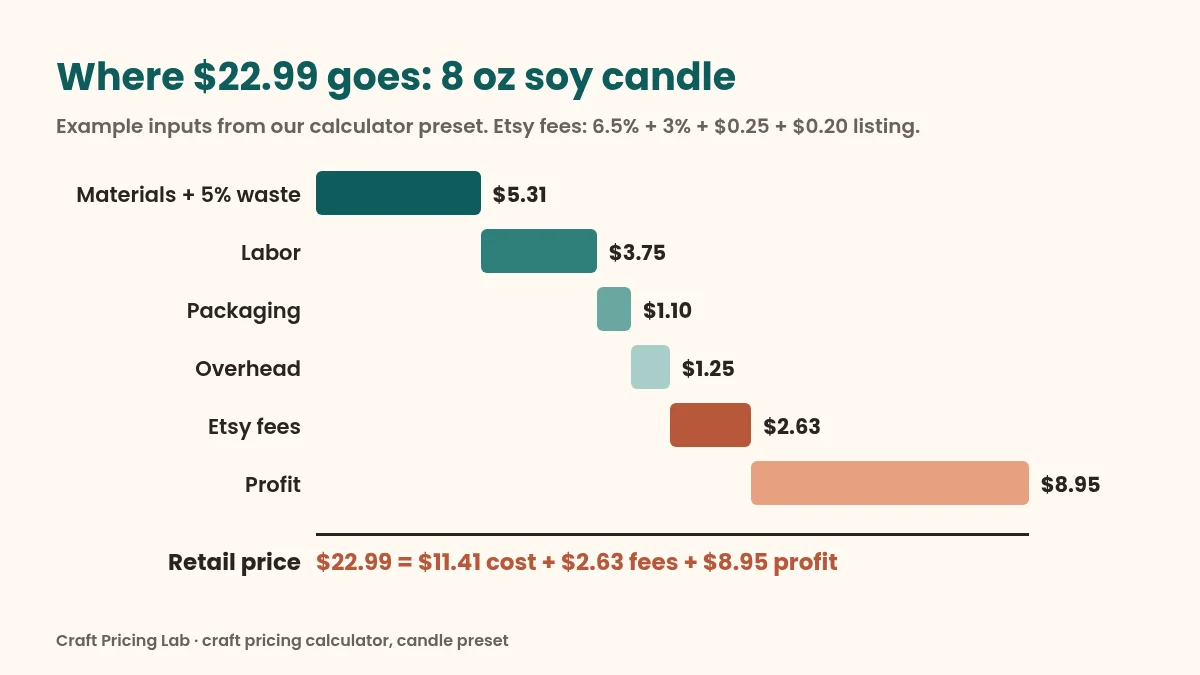
Notice that the $8.95 profit comes on top of your $3.75 labor, so you are paid for your time and the business still earns something to grow with. That profit pays for new molds, slow months and the candles that never sell.
The break-even line is useful when you plan a sale. Any discount that takes the price below $13.10 loses money on Etsy, even before Offsite Ads.
Try it with your numbers. Open the craft pricing calculator with the candle example loaded, then change the inputs to match your own costs.
Using a different free tool? Our test of four free craft pricing calculators shows which ones leave out packaging, overhead or Etsy fees.
Does your price fit the market?
A formula tells you what you need, but it cannot tell you what buyers will pay, so the last step is a market check. Look up 15 to 25 items that match yours in size and material, then find the middle price.
We did this for the four example products in our calculator. On October 11, 2026 we sampled Etsy search results for single items only, with no sets or bundles, and took the median list price. The costs are our example inputs, so treat this as a method demo, not a price guide.
| Example product | Cost per item | Cost × 2 × 2 | 50% margin | Etsy median (sample size) |
|---|---|---|---|---|
| 8 oz soy candle | $11.41 | $45.99 | $22.99 | $21.00 (19) |
| Cold process soap bar | $6.87 | $27.99 | $13.99 | $8.59 (13) |
| Crochet toy | $71.54 | $286.99 | $143.99 | $48.36 (20) |
| Beaded bracelet | $9.44 | $37.99 | $18.99 | $33.38 (26) |
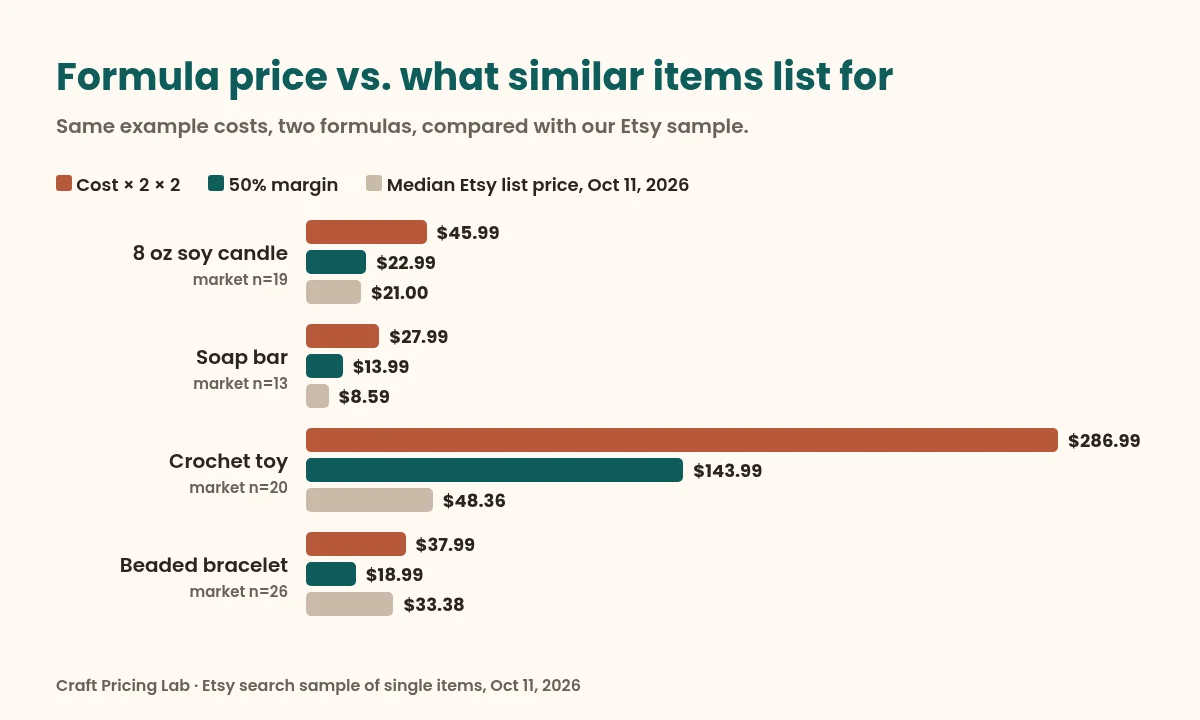
The pattern is clear. The × 4 rule priced every example above its market median, from 1.1 times for the bracelet to 5.9 times for the crochet toy. The 50% margin landed close to the market for the candle, above it for the soap and crochet toy, and well below it for the bracelet.
A price below the market is good news. The bracelet could likely sell for more, so test a higher price before you change anything else. A price far above the market is the hard case, and the next section deals with it.
What should you do when the formula says more than buyers pay?
When your price is far above similar items, cutting the price alone just moves the loss into your pay. The crochet toy shows why. At the $48.36 market price, the example maker would earn about $9.74 an hour on Etsy, well under the $18 rate in that example.
Work through these options in order, because each one changes the math for you instead of hiding it.
- Cut the time per item. Batch the steps you repeat, simplify a pattern, or prep parts in bulk. In the crochet example, labor is $61.50 of the $71.54 cost.
- Lower the material cost. Buy the supplies you use most in larger packs, and check your waste number against real batches.
- Show why yours costs more. Bigger size, better materials or custom work can justify a price above the median. Say so in the title and the first photo.
- Change the product. A smaller version, a set, or a kit can hit a price buyers accept while keeping your rate.
- Retire it. Some items only work as a hobby. Keeping them in the shop can pull down the profit of everything else.
Run the market check again after each change. The goal is a price that pays your chosen rate and sits within reach of what buyers already pay for similar work.
Common pricing mistakes that cost handmade sellers money
Underpricing often comes from a few small gaps, not one big error. Check your current prices against this list.
- Leaving out admin time. Listing, photos and packing are work, and they belong in your labor cost.
- Pricing from one competitor. One shop may be closing down or using cheap supplies. Use the median of a group.
- Forgetting fees on shipping. Etsy’s transaction fee applies to the shipping you charge, not only the item.
- Using the same price on every channel. A fair booth, your site and Etsy take different cuts. Check profit on each.
- Never raising prices. Supply costs change. Review your numbers every few months and when a supplier raises prices.
A good habit is a short price review every three months. Update material prices from your latest receipts, re-run the calculator, and look at the market again. It takes less than an hour and catches most of these gaps.
Frequently asked questions
What is the formula for pricing handmade items?
Add materials with waste, labor, packaging and a share of overhead to get your cost per item. Then divide by (1 − your target margin). With a 50% margin, an $11.41 cost becomes $22.82, which you can round to $22.99. Check the profit after fees and compare it with similar listings.
Should you charge for your time when pricing crafts?
Yes. Pick an hourly rate and multiply it by your making and admin minutes, then divide by the items in the batch. The US federal minimum wage of $7.25 an hour is a sensible floor. Without labor in the cost, the price only works while you work for free.
Is the cost × 2 × 2 rule still a good idea?
It works well if you sell to shops, because it leaves room for a wholesale price. For direct sales it often lands well above the market. In our four-product check it was 1.1 to 5.9 times the Etsy median. A target margin is easier to match with what buyers pay.
How much does Etsy take from a sale?
For a US seller, Etsy charges a $0.20 listing fee, a 6.5% transaction fee and 3% + $0.25 for payment processing. On a $22.99 candle that is about $2.63. A sale from an Offsite Ad adds 15%, or 12% for shops with $10,000 or more in yearly sales.
How can you tell if your price is too high?
Find 15 to 25 items that match yours in size and material and take the middle price. If yours is much higher, either show clear reasons it is worth more or lower your cost per item. If yours is lower, you likely have room to raise it.
Fee figures were checked against the platforms’ published fee pages on October 12, 2026. Read how we calculate.