
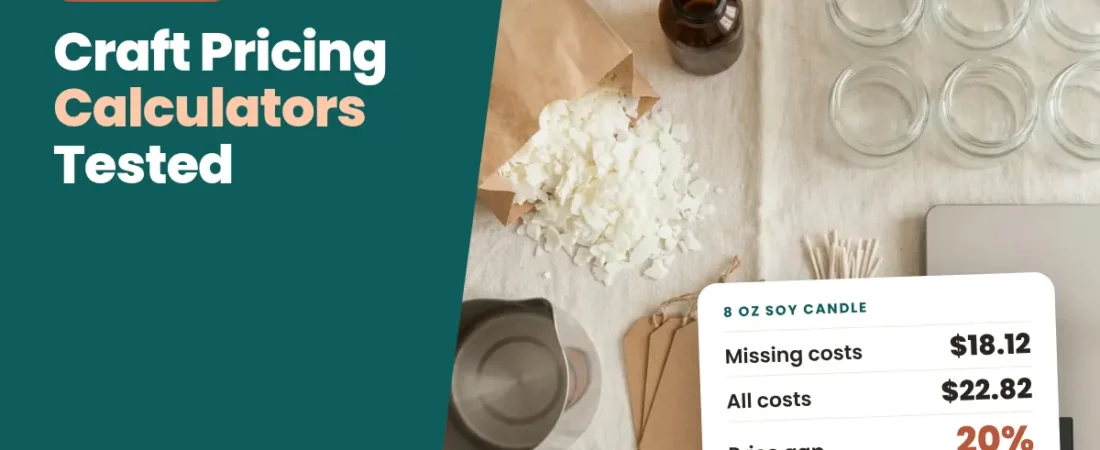
Free craft pricing calculators promise a fair price in seconds, but they count different costs. We ran one 8 oz soy candle through four free tools on October 12, 2026. Every tool did the arithmetic right, yet your price could land anywhere from $18.12 to $22.99. Some tools leave out packaging, overhead or Etsy fees.
The short answer
- Best for most Etsy sellers: Handmade Price Calculator. It counts fees, overhead and break-even, and matched our numbers to the cent.
- Best for batch makers and wholesale: MakerGauge. It handles batches, failed batches and wholesale prices.
- Quick markup check only: Craftybase and Craft Professional. They are correct, but you must add packaging, overhead and fees yourself.
- No tool paid us and this article has no affiliate links.
How did we test the craft pricing calculators?
We used one product with a known answer, so every tool could be checked against the same numbers. The product is the 8 oz soy candle from our guide on how to price handmade items.
You can load the same inputs with one click in our Craft Pricing Calculator. Every formula is written out on How We Calculate, so you can repeat any step.
Here is what one candle really costs. Materials come to $5.31, including 5% waste. Labor is $3.75, which is $20 an hour for 135 minutes of work spread over a batch of 12. Packaging adds $1.10, and overhead adds $1.25, which is $150 a month spread over 120 candles. Your cost per candle is $11.41.
| Cost part | Per candle | How it was worked out |
|---|---|---|
| Materials with 5% waste | $5.31 | $60.68 of supplies ÷ 12 candles × 1.05 |
| Labor | $3.75 | $20 an hour × 135 minutes ÷ 60 ÷ 12 |
| Packaging | $1.10 | Box, tissue and label |
| Overhead | $1.25 | $150 a month ÷ 120 candles |
| Cost per candle | $11.41 | Sum of the four parts |
At a 50% margin, your price is $11.41 ÷ 0.5 = $22.82, rounded up to $22.99. On Etsy, that sale pays $2.63 in fees and leaves you $8.95 of profit. Your break-even price, where profit is zero, is $13.10.
A tool passed our math test when its answer was within 1% of these numbers on the same inputs.
We also checked each page at a phone width of 390 pixels and noted what each tool asks you to enter. We did not score support, privacy or update history, so this is not a full review with star ratings. Our review method explains what a full score needs.
Which free craft pricing calculators did we test?
We picked free tools that show up in a search for a craft or handmade pricing calculator and work without an account. Four tools met that bar. A fifth, CraftWorth, is a paid app from $7 a month with a 14-day trial. It needs an account, so it is not in this free test.
| Tool | What you enter | Counts fees? | Phone check |
|---|---|---|---|
| Handmade Price Calculator | Materials, packaging, hours, rate, shipping, overhead, ads, returns | Yes, editable Etsy fees | Fits the screen |
| MakerGauge | Batch size, batch materials, minutes, failure rate, packaging, overhead | Yes, one fee rate plus a fixed fee | Fits the screen |
| Craft Professional | Six small calculators: markup, wholesale, hourly, overhead, Etsy, profit goal | Only as a dollar amount you type | Not measured, ads blocked the check |
| Craftybase | Markup, labor cost, material cost | No | Page wider than the screen |
All four are free to use, and none asked for your email to show a result. The difference is how much of your real cost each one sees.
Fewer fields make a tool faster to use. But every missing field is a cost you have to remember and add by hand. That trade-off decides which tool fits your shop.
We also include our own calculator as the source of the test inputs, not as a contestant. Ranking our own tool against the others would not be a fair test, so it is not in the verdict.
What did each tool get right and wrong?
Each tool got the math right. What changed the price was what each tool let us enter.
Handmade Price Calculator
This was the most complete Etsy tool in the test. We entered the candle at $22.99 in its price-check mode. It showed a $0.20 listing fee, $1.49 transaction fee and $0.94 payment fee, a total of $2.63, and $8.95 of profit. Its break-even mode, with rounding off, gave $13.10. Both match our numbers exactly.
You can edit the fee fields, and Offsite Ads is a separate switch. The page says your numbers stay in your browser and that its method was reviewed on July 21, 2026.
The one thing to watch is the word margin. It shows 38.9% at $22.99, because it measures profit after fees, while our 50% margin is measured before fees.
MakerGauge
MakerGauge thinks in batches, which suits you if you pour, cut or mix in runs. We entered 12 candles, $63.71 of materials with waste included, 135 minutes of labor at $20 an hour, packaging and $150 of monthly overhead over 120 units.
It returned a unit cost of $11.41 and a break-even price of $13.10, both exact.
At a 25% target margin after a 9.5% fee rate and a $0.45 fixed fee, it suggested $18.11, which is exactly what the formula gives. It adds things the others skip, like a failed-batch rate and a wholesale price.
There is no waste field, so you add waste to your materials yourself. Its fee rate is also general, so you enter your own channel’s rate.
Craft Professional
This page holds six small calculators, each built around one formula. With all costs entered as materials, the basic markup tool gave $22.82. The overhead tool, with profit typed in as $11.41, also gave $22.82. Both are correct for the formula they use, and the page explains each formula in plain words.
The Etsy calculator is the weak spot. You type Etsy fees as a fixed dollar amount, so you must already know your fees before the tool can price around them. Your packaging is added after the markup, so it earns no margin.
The page was last updated in May 2024, and heavy video ads slowed it down in our test.
Craftybase
Craftybase asks you for only three numbers: markup, labor cost and material cost. We ran all four of our test products through it, and the math was right every time.
With $5.31 of materials and $3.75 of labor at a 100% markup, it suggested $18.12. Type your packaging and overhead into the material box as well, and you get $22.82.
The risk is the profit line. It shows you $9.06 of profit at $18.12, but that is before Etsy takes about $2.17 in fees, and before packaging and overhead.
At a phone width of 390 pixels, the page was 428 pixels wide, so it scrolled sideways. The calculator works as a quick check, and the page also promotes a 14-day trial of the paid Craftybase app.
Why do the same costs give different prices?
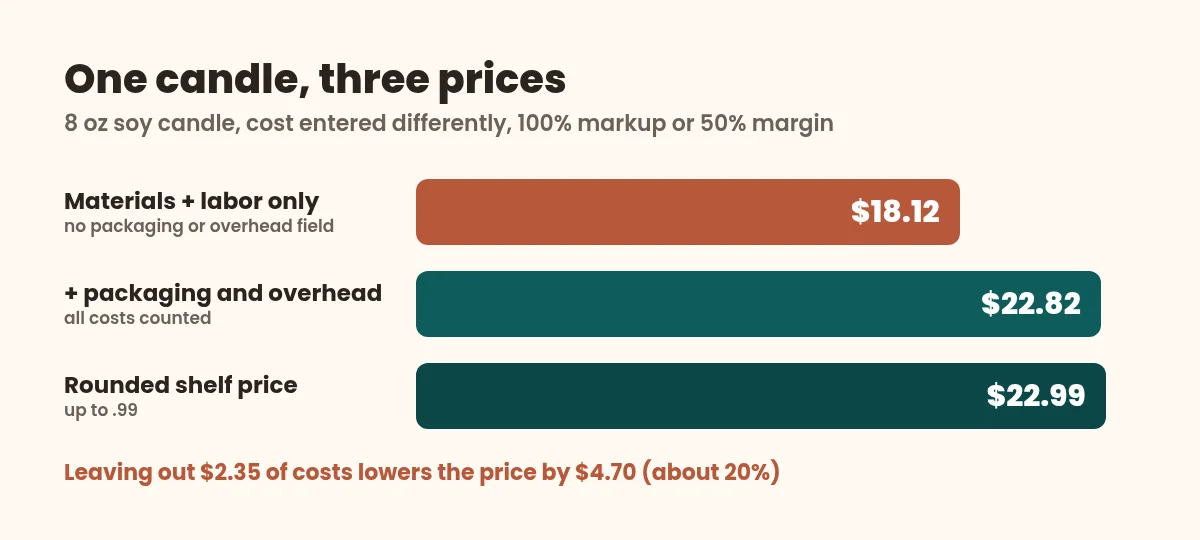
The gap between $18.12 and $22.99 is not a math error. It comes from costs a tool never asks about. Packaging and overhead add $2.35 to each candle, and a markup doubles that gap. Leave them out and the price drops by $4.70, about 20%.
That 20% is real money for you. At 120 candles a month, $4.70 per candle is $564 a month that your shop pays out of its own pocket. Most of it would have paid for jars, boxes, software and your slow months.
The tool did nothing wrong. It simply had no field for those costs, so it never added them.
Fees work the same way. A tool that shows profit before fees makes each of your sales look $2 to $2.63 better than it is at these prices.
On a $22.99 candle, Etsy keeps 6.5% of the order, 3% plus $0.25 for payment processing, and a $0.20 listing fee. These rates come from Etsy’s fee help page, checked on October 12, 2026.
A quick way to test any calculator you find is to enter a product you already know well. If your suggested price only changes when you edit materials and labor, the tool is ignoring the rest of your costs.
If it never asks where you sell, it is ignoring your fees. Either way, you can still use it, but add those costs by hand first.
Is a 50% margin the same in every calculator?
No. Some tools measure margin before fees and some measure it after, so the same percentage can mean different prices. Our calculator and Craftybase use margin before fees: at $22.99, the candle keeps about 50% of the price over its cost. Handmade Price Calculator and MakerGauge measure profit after fees.
Measured after fees, that same $22.99 candle has a 38.9% margin, because $8.95 of profit is 38.9% of the price. Both numbers describe the same sale.
The trap is moving from one tool to another and typing the same 50% target. For your candle, a 50% after-fee target gives $29.28, while a 50% before-fee target gives $22.82.
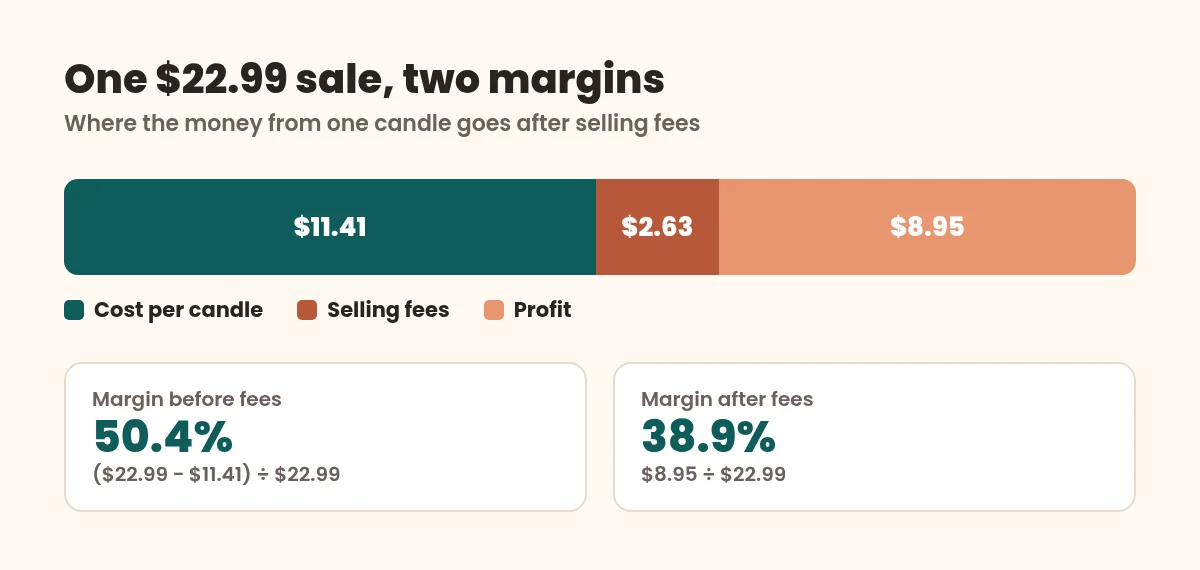
Neither definition is wrong. What matters is that you know which one a tool uses before you copy its price. Look for words like after fees, net margin or profit margin after selling costs.
When a tool does not say, enter your price and check whether the profit it shows already has fees taken out.
If you sell on several channels, after-fee margins are easier for you to compare, because each channel takes a different cut. If you mostly want a price to start from, a before-fee margin is simpler. Pick one way of measuring and keep it for every product in your shop.
Which calculator should you use?
Choose the tool that sees most of your real costs with the least typing for you. If you run an Etsy shop with steady products, Handmade Price Calculator is the strongest free choice we tested. It counts fees, packaging, overhead and break-even in one place, and its numbers matched ours to the cent.
| Your situation | Good fit | Why |
|---|---|---|
| Etsy shop, one item at a time | Handmade Price Calculator | Etsy fees, Offsite Ads switch, break-even and rounding |
| Batches, failed runs or wholesale | MakerGauge | Batch costs, failure rate, wholesale and retailer prices |
| Learning the classic formulas | Craft Professional | Six formulas on one page with plain explanations |
| A quick markup check | Craftybase | Three fields, instant answer, add other costs into materials |
| Craft examples and a market check | Our calculator | Candle, soap, crochet and bracelet presets with an Etsy price check |
If you make in batches, MakerGauge is worth the extra fields. Its failed-batch rate matters for soap, resin and candles, where one bad pour can wipe out a batch. If you also sell wholesale, it gives you a minimum wholesale price that still keeps your margin, which the other free tools did not.
Whatever tool you pick, do one test before you trust it with your prices. Enter a product you know, then add up your costs on paper. If the two answers differ by more than a few cents, find the missing field before you set any prices with it.
What should a pricing calculator include?
A good handmade pricing calculator asks for every cost that leaves your pocket, then shows what is left after fees. Use this list to judge any tool, including ones we did not test. If a tool misses one item, you can still use it, as long as you add that cost by hand.
- Materials per item, with a way to add waste or failed pieces.
- Labor as an hourly rate times your minutes, including admin time.
- Packaging that ships with each order.
- Overhead spread over the items you sell each month.
- Selling fees for your channel, taken from the price, not added on top.
- Break-even price, so you know how far a sale can go.
- A clear margin definition, before or after fees.
Two extras make a tool better. Rounding to a price like $22.99 saves a step. A way to compare your price with similar listings shows if buyers will pay it. Our calculator adds that market check for its four example products, and our pricing guide shows how to do it by hand.
Frequently asked questions
What is the best free craft pricing calculator?
In our October 12, 2026 test, Handmade Price Calculator was the most complete free option for Etsy sellers. It counts fees, packaging, overhead and break-even, and matched our candle numbers exactly. MakerGauge is the better pick if you make in batches or sell wholesale. Both are free and need no account.
Are free pricing calculators accurate?
The four we tested did the math correctly every time. Accuracy problems came from missing inputs, not wrong arithmetic. A tool without packaging, overhead or fee fields priced our candle about 20% lower than its real cost needed. Check which costs a tool asks for before you trust its price.
Does the Craftybase calculator include Etsy fees?
No. The free Craftybase calculator asks for markup, labor cost and material cost only. Its profit figure is before Etsy fees, packaging and overhead. You can type packaging and overhead into the material box, but you still need to subtract Etsy fees yourself to see real profit.
Why does a calculator show a lower margin than you set?
Your tool probably measures margin after fees. A $22.99 candle that costs $11.41 has about a 50% margin before fees but 38.9% after $2.63 of Etsy fees. Both are right. Pick one definition and use it for every product, so your prices stay consistent across your shop.
How can you check a pricing calculator yourself?
Enter one product whose costs you know, then work the price out on paper: cost per item divided by one minus your margin. Compare the two answers. If they differ by more than a few cents, look for a cost the tool leaves out, such as packaging, overhead or fees.
Fee figures were checked against the platforms’ published fee pages on October 12, 2026. Tool tests ran on October 12, 2026; features and prices can change. Read how we calculate and how we review.